LEARN ABOUT
Tawantinsuyu (Inka Empire)
Tawantinsuyu was a rapidly expanding Andean empire centered on Cusco, not a timeless communal society or an early version of a modern ideology. Between the expansion associated with Pachakuti and the Spanish seizure of Cusco in 1533, its rulers combined ranked authority, local government, compulsory labor, negotiation, warfare, roads, and stored provisions across highly varied regions.
Sources for the short answer2 claims
observation
The bounded case begins with expansion conventionally associated with Pachakuti in the fifteenth century and ends with the Spanish seizure of Cusco in 1533; exact accession and conquest chronologies remain disputed.
editorial interpretation
This imperial case does not embody socialism, communism, statelessness, or timeless Andean collectivism: it joined communal institutions and reciprocal idioms to ranked authority, conquest, compulsory labor, royal estates, and local variation.
QUESTION
What do Tawantinsuyu, Inka, and Inca mean?
Tawantinsuyu refers to a polity organized as four quarters joined around Cusco. Inka can refer to a ruler, privileged people, or the polity, while Inca is the familiar Spanish and English spelling. Using all three names helps readers find the subject without pretending that colonial spellings or modern national borders are neutral. The start date near 1438 is conventional rather than exact, and 1533 marks the seizure of Cusco rather than the disappearance of Inka people or political action.
Sources for “What do Tawantinsuyu, Inka, and Inca mean?” 4 claims
definition
Tawantinsuyu names the Inka polity as four joined regions centered on Cusco.
definition
Historical and scholarly uses of Inka can refer to rulers, royal and privileged groups, or the wider polity, so the term does not identify every incorporated person in the same way.
editorial interpretation
This guide uses Inka for Quechua names and retains Inca in conventional English titles and search terms; spelling alone does not settle political identity.
observation
The bounded case begins with expansion conventionally associated with Pachakuti in the fifteenth century and ends with the Spanish seizure of Cusco in 1533; exact accession and conquest chronologies remain disputed.
QUESTION
How did authority, labor, and provisioning work?
The Sapa Inka stood at the top of imperial rule, but he governed through royal kin, officials, provincial authorities, and local kurakas. Royal descent groups controlled estates and shaped succession, while incorporated leaders often retained authority in return for labor, allegiance, and provisioning. Those arrangements varied with distance, earlier institutions, resistance, and the way a population entered the empire. Tawantinsuyu was therefore an empire and a state, but neither label should imply uniform administration everywhere.
Sources for “Who ruled, and through whom?” 3 claims
observation
The Sapa Inka stood at the apex of imperial authority, but royal descent groups and estates organized resources and succession interests, so rule was not the action of one unencumbered individual.
observation
Imperial officials commonly governed through local kurakas and negotiated obligations, while strategies varied with prior political organization, resistance, distance, and regional importance.
observation
Expansion combined warfare and threats with diplomacy, gifts, ritual claims, and negotiated retention of local leaders; incorporation was neither wholly consensual nor mechanically uniform.
Households supplied rotating mit’a labor for farming, construction, transport, armies, and specialized production. State institutions provisioned some of that service from fields and storehouses, while communities, shrines, and royal estates retained distinct claims on land, work, and goods. Roads moved officials, messengers, armies, and supplies, yet they were built with local labor and knowledge and do not prove equal control in every province. Resettlement of mitmaq populations and specialized service by acllakuna also show that status, gender, and coercion shaped who moved and worked.
Sources for “How were labor and resources organized?” 6 claims
observation
Households owed rotating mit’a service for farming, construction, transport, military, craft, and other state projects; this was a labor obligation, not adequately described as a wage contract or a uniform tax in goods.
observation
Subject communities, state institutions, shrines, and royal estates held distinct claims on labor and resources; calling all land simply communal or state-owned erases those divisions.
observation
The imperial road system joined earlier routes to new construction and depended on the labor and landscape knowledge of incorporated populations.
editorial interpretation
Roads enabled official travel, armies, messages, and provisioning, but their extent does not by itself establish identical administration or effective control in every province.
observation
Imperial authorities relocated mitmaq populations for production, security, colonization, and political control, making mobility both an administrative instrument and a source of coercion.
observation
Work, ritual office, residence, and access to resources varied by gender and status, including specialized service by acllakuna; complementary roles did not eliminate hierarchy or coercion.
QUESTION
What changed between expansion and invasion?
- caseTawantinsuyu imperial organization
A bounded study of rule, labor, provisioning, and differentiated incorporation during Tawantinsuyu’s fifteenth-century expansion through the seizure of Cusco in 1533.
- case episodeExpansion and consolidation, c. 1438–1527
Expansion and provincial consolidation before the succession crisis.
- case episodeSuccession war and invasion, c. 1527–1533
The succession conflict, Spanish invasion, and seizure of Cusco that disrupted imperial rule.
QUESTION
What can the evidence establish, and what is disputed?
Recorded storehouses in Xauxa and excavated crops and vessels show large-scale accumulation coordinated by the state. At Huánuco Pampa, plazas and compounds created both broad meeting spaces and restricted encounters between Inka and provincial elites. These remains support claims about provisioning and differentiated access, but they cannot by themselves reveal how every worker understood an obligation or how benefits were distributed.
Sources for “What do material remains show?” 2 claims
observation
Excavated Xauxa storehouses contained major highland crops and storage vessels, while their distribution indicates centrally coordinated accumulation and disbursement with dispersed material support.
observation
Huánuco Pampa’s plazas, compounds, and restricted palace spaces show a planned provincial center where officials and local groups met through differently accessible settings.
John Murra interpreted imperial labor through Andean reciprocity and redistribution: rulers mobilized service while claiming duties to provision and protect subjects. Terence D’Altroy and Timothy Earle instead foreground staple finance, in which compulsory labor and stored goods sustained administration and force. The interpretations are not simple opposites because reciprocal language, material provision, political negotiation, and coercive extraction could operate together. Calling the arrangement only tribute, only reciprocity, or only redistribution hides the dispute that evidence must resolve place by place.
Sources for “Was it reciprocity, redistribution, or extraction?” 4 claims
observation
Murra interpreted state labor mobilization through Andean reciprocity and redistribution, emphasizing obligations presented through idioms of mutual provision rather than commodity exchange.
observation
D’Altroy and Earle analyze labor and stored staples as finance for state power, foregrounding compulsory extraction and logistical control that a reciprocity-only account can obscure.
observation
Households owed rotating mit’a service for farming, construction, transport, military, craft, and other state projects; this was a labor obligation, not adequately described as a wage contract or a uniform tax in goods.
observation
Excavated Xauxa storehouses contained major highland crops and storage vessels, while their distribution indicates centrally coordinated accumulation and disbursement with dispersed material support.
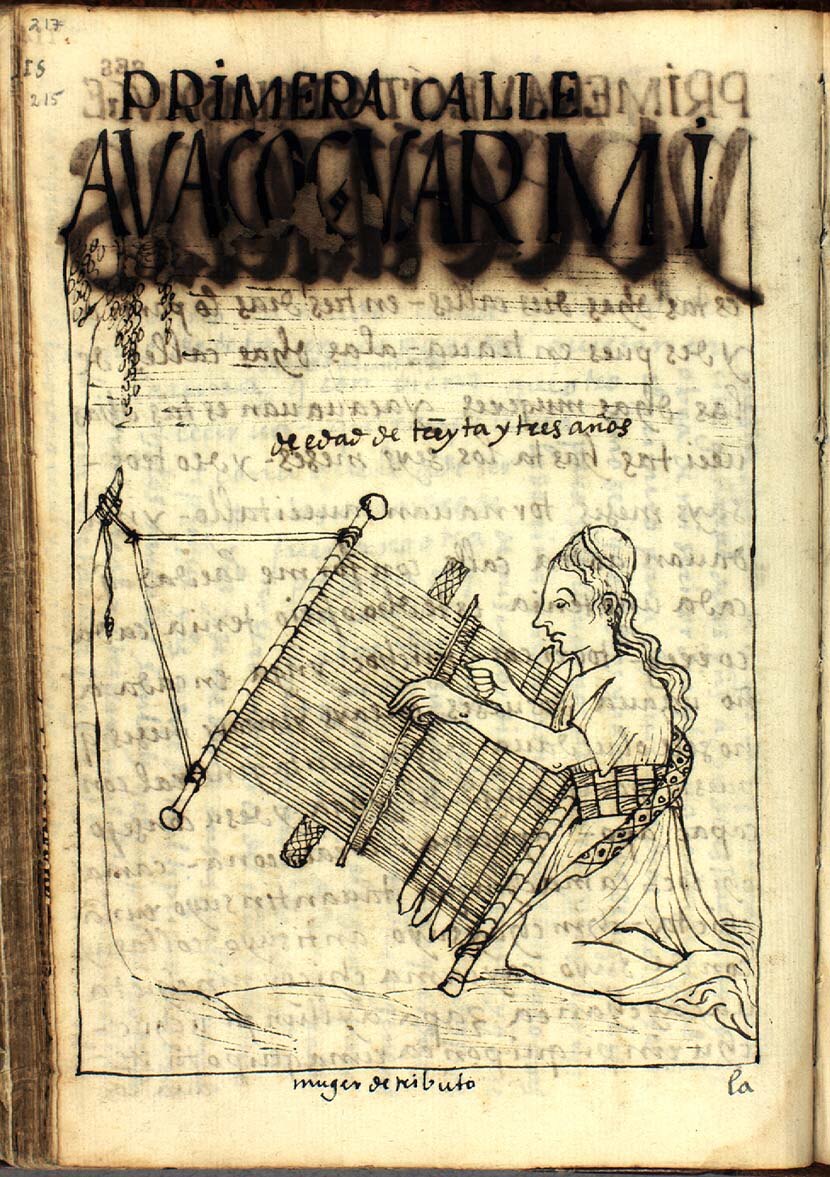
Pedro de Cieza de León wrote within a Spanish colonial chronicle, and Felipe Guaman Poma de Ayala addressed a Christian illustrated petition to the Spanish king decades after invasion. Guaman Poma’s age-graded census pages preserve Quechua labels and distinguish young men assigned military and messenger duties from older men assigned lighter work. Both records are indispensable, but translation, genre, colonial pressure, political argument, and retrospective memory mediate what they say. Archaeology can challenge or corroborate parts of those accounts; it does not remove the need to ask whose testimony survives.


Sources for “How should colonial accounts be read?” 3 claims
observation
Cieza composed his second chronicle in the 1550s, and Guaman Poma completed his manuscript around 1615; both recorded Andean institutions after invasion through colonial Spanish genres shaped by translation, Christian argument, political purpose, and retrospective reconstruction.
observation
Guaman Poma’s census chapter differentiates service by age: its first-age entry assigns young men military and messenger duties, while its second-age entry assigns older men lighter work.
observation
Huánuco Pampa’s plazas, compounds, and restricted palace spaces show a planned provincial center where officials and local groups met through differently accessible settings.
QUESTION
What remains unresolved?
counterevidence / open
How did labor burdens, local authority, access to provisions, and resettlement differ by province, mode of incorporation, status, and gender between about 1438 and 1533?
Regional syntheses establish variation but the present evidence does not support a commensurable population-level distribution of burdens and benefits across the empire.
- Evidence needed
- Preselected provincial comparisons combining settlement archaeology, storage and production evidence, local documentary testimony, bioarchaeology, and explicit sampling limits.
- Scope
- Named provinces and populations during the bounded imperial period; no inference from one administrative center to all Tawantinsuyu.
Claims and evidence for “How did labor burdens, local authority, access to provisions, and resettlement differ by province, mode of incorporation, status, and gender between about 1438 and 1533?”
Claims this question tests
observation
Imperial officials commonly governed through local kurakas and negotiated obligations, while strategies varied with prior political organization, resistance, distance, and regional importance.
observation
Expansion combined warfare and threats with diplomacy, gifts, ritual claims, and negotiated retention of local leaders; incorporation was neither wholly consensual nor mechanically uniform.
research gap / open
Where do colonial Spanish terms for tribute, lordship, property, and service distort or incompletely translate Quechua and Aymara categories in accounts of Tawantinsuyu?
The chronicles preserve Indigenous terms inside colonial genres, but the current ledger does not compare manuscript variants, original-language usage, or modern community interpretation term by term.
- Evidence needed
- Critical editions, manuscript images, historical-linguistic analysis, and Quechua- and Aymara-led scholarship or community review with provenance for translation choices.
- Scope
- Terms used for imperial institutions in sixteenth- and early-seventeenth-century records; not a claim that modern speakers share one interpretation.
Claims and evidence for “Where do colonial Spanish terms for tribute, lordship, property, and service distort or incompletely translate Quechua and Aymara categories in accounts of Tawantinsuyu?”
Claims this question tests
observation
Cieza composed his second chronicle in the 1550s, and Guaman Poma completed his manuscript around 1615; both recorded Andean institutions after invasion through colonial Spanish genres shaped by translation, Christian argument, political purpose, and retrospective reconstruction.
observation
Guaman Poma’s census chapter differentiates service by age: its first-age entry assigns young men military and messenger duties, while its second-age entry assigns older men lighter work.
counterargument / open
Which observations would distinguish reciprocal obligation with material return from compulsory extraction in particular Tawantinsuyu labor and provisioning settings?
The rival interpretations identify compatible mechanisms, while storage totals and chroniclers’ normative language do not by themselves measure who contributed, received, consented, or resisted.
- Evidence needed
- Local labor schedules, consumption and distribution evidence, household effects, testimony about obligation and refusal, and comparisons across state, shrine, estate, and community claims.
- Scope
- Specified labor and provisioning settings within Tawantinsuyu before 1533; excludes using modern ideological labels as outcomes.
Claims and evidence for “Which observations would distinguish reciprocal obligation with material return from compulsory extraction in particular Tawantinsuyu labor and provisioning settings?”
Claims this question tests
observation
Murra interpreted state labor mobilization through Andean reciprocity and redistribution, emphasizing obligations presented through idioms of mutual provision rather than commodity exchange.
observation
D’Altroy and Earle analyze labor and stored staples as finance for state power, foregrounding compulsory extraction and logistical control that a reciprocity-only account can obscure.
observation
Excavated Xauxa storehouses contained major highland crops and storage vessels, while their distribution indicates centrally coordinated accumulation and disbursement with dispersed material support.